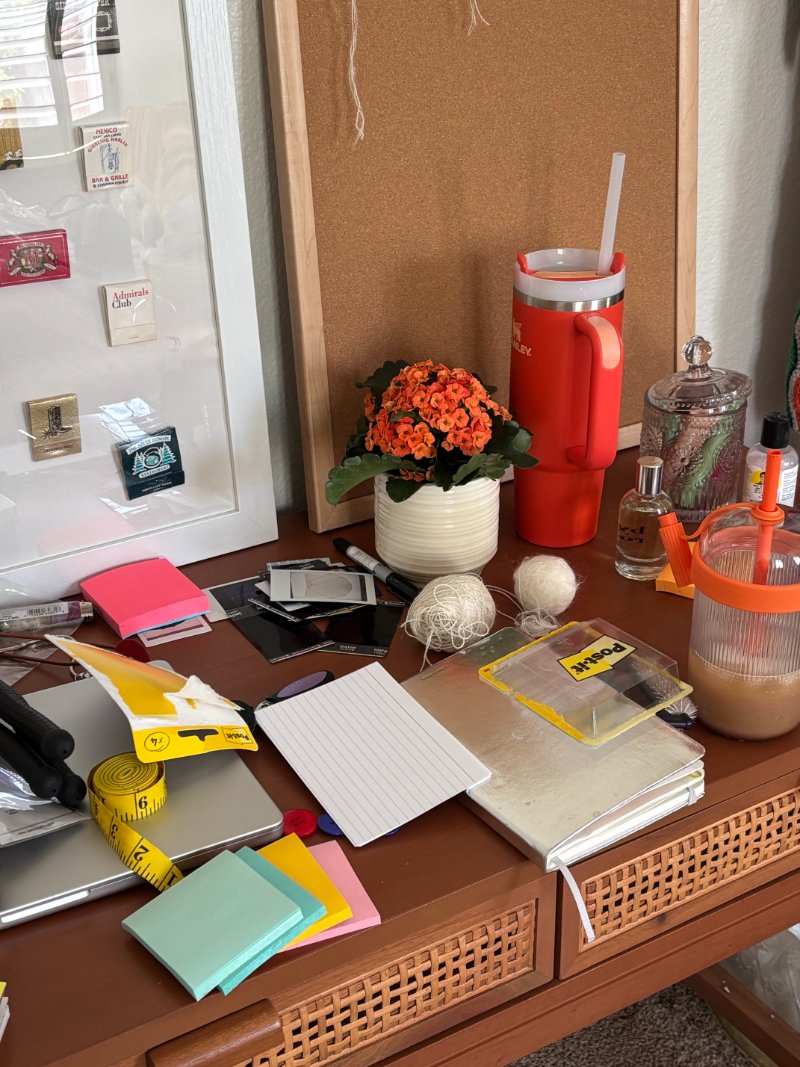
You sit down at your desk to finally get some work done. Then you look up: there's mail you haven't opened, the bag that's been waiting to go to the op shop for a month, three mugs, a stack of papers you've been meaning to file away, and a box of craft supplies for a project you're definitely starting soon. None of it is making a sound, but somehow it feels so bloody loud.
That's visual noise. Every item sitting in your line of sight is a tiny unfinished job, and each one is elbowing its way into your brain for a bit of your attention. And if you work from home, there's no walking away from it at the end of the day, either.
Hello! I'm Bea, a medical doctor turned Certified Speed of Life Decluttering Coach (trained by Dana K. White), and I am not naturally organised. I recently chatted with the extremely awesome Deanna Seymour on her podcast, Big Fun, Small Business, about ADHD, visual noise and decluttering without the judgment.
This post pulls together the parts of that conversation I most wanted to share with you. And if you'd like a hand turning down the noise in your own home, I offer online decluttering sessions anywhere in the world and in-home decluttering in Canberra.
Table of Contents
What Is Visual Noise, And Why Is It So Tiring?
Visual noise is the background hum of having lots of Stuff in view. It's rarely one big mess. It's dozens of small things, and every single one is a decision you haven't made yet.
As I said to Deanna, business owners already wear about 17 hats. Most of us are also carrying a pretty big mental load at home. Your office might be your little sanctuary, but it might also be a hot mess, and when you step in to concentrate on work, there are 50,000 other things in there competing for your brain.
Here's what all that stuff is saying to you, all day long:
"Put me away."
"Clean me up."
"Take me to Vinnies."
"Remember, you said you'd fix me."
One of the most surprising things for me was that as stuff left my house, the mental noise went down a lot too. I've seen the same thing again and again with my clients. Less stuff in the room tends to mean less noise in your head.
Why Visual Noise Hits Differently-Wired Brains Harder
A lot of us who are neurodivergent (who have ADHD, Autism, AuDHD, or a brain that has never quite been given a label) also live with sensory sensitivities. For brains like ours, the visual noise of stuff piled up everywhere can be genuinely overwhelming.
As excess stuff starts to leave, things start to feel a lot calmer in your brain (or at least it's slightly less like a squirrel circus. The squirrels are still there, but now they're having a nice cup of tea and a minute to relax.)
Deanna pointed out the unfair bit (and she's right): a calm space is extra good for neurodivergent people, and it's also extra hard for us to keep it that way.
Planning, prioritising and decision-making are tricky for many of us. On top of that, our wonderfully creative brains see potential in everything. Dana K White calls this delightful trait ‘infinity brain’.
We can pick up an empty box and think it could be a race car for the kids. A scrap of fabric could become a quilt, or a blanket for a doll's bed. We can think of 50 uses for an item that your average neurotypical brain would never come up with in a million years, so that can make letting go of things extra hard. (“What if I need this for when I finally get into découpage?!”)
Then, there's ‘time optimism’ (which is my preferred term for what’s often called time blindness). It’s a challenge with time perception that’s common with ADHD, where how long you expect a task to take can be wildly different from how long it really takes. I'm currently restoring our kitchen table, and when I started stripping the shellac off the top, I thought it would take an hour. It did not. (Spoiler alert: it really, really did not.)
If you'd like more on this, I've written about whether clutter is a sign of ADHD and what the research says.
Your House Is A Container (and so is everything in it)
This is a foundational idea I learned from my teacher, Dana K. White, who wrote Decluttering at the Speed of Life (which I highly, highly recommend). She calls it the Container Concept.
The word container comes from the word ‘contain’, which means ‘to limit’. So a container isn't only a thing we put stuff in. It's a limit on how much stuff can fit in there. A tub from the $2 shop is a container; so is a shelf, a cupboard, your bedroom and your whole house.
It's a simple idea, and when it finally clicked for me, my brain went: “Oh my goodness, this changes everything.”
It helps to think about three budgets:
Your time budget. How much time you really have for projects (see: my Kitchen Table Shellac Saga).
Your capacity budget. Many of us have fluctuating energy, plus caring responsibilities, work and a business to run. So we only have so much we can do before our battery runs out.
Your space budget. Your home can only hold so much. Our ideas fit in our heads, but the stuff that comes with them often doesn't physically fit in our space.
The obvious solution that a lot of us default to is just getting a bigger container. But (rather inconveniently) when that container is your house, buying a bigger one gets expensive pretty quickly.
People Deserve Space More Than Stuff
Here's the part of the Container Concept I love most: the first thing that deserves space in your home is the people who live in it. Kids need room to play. You need room to invite people over, sit down for a meal together, and lie on the couch watching Ted Lasso. (Years ago, that meant I had to move the permanent pile of washing off my couch. Do not recommend.)
After that, it's not my job to tell you what you can or can't keep. If you have a model train collection or a box of extra Christmas decorations in the attic, but it fits in the available space and you can keep it tidy, you do you! Christmas that attic up!
The Container Concept also helps in a really practical way. When your stuff fits in its container, it stops spilling out into view. With the Christmas stuff at my place, we have one box of decorations. Whatever fits in that box is the room we have for Christmas decorations. If something new doesn't fit, I either swap it for something less container-worthy, or it has to leave my home. It’s not because I don’t like it or think it’s cool; there just isn’t enough space for it.
Doom Boxes, Maybe Boxes And The "Time Will Tell" Bin
Sometimes the visual noise of everything being out is too distressing, but you don't have the capacity to deal with it yet. Putting it all in a box so it's at least contained? That's a legitimate coping strategy. Really!
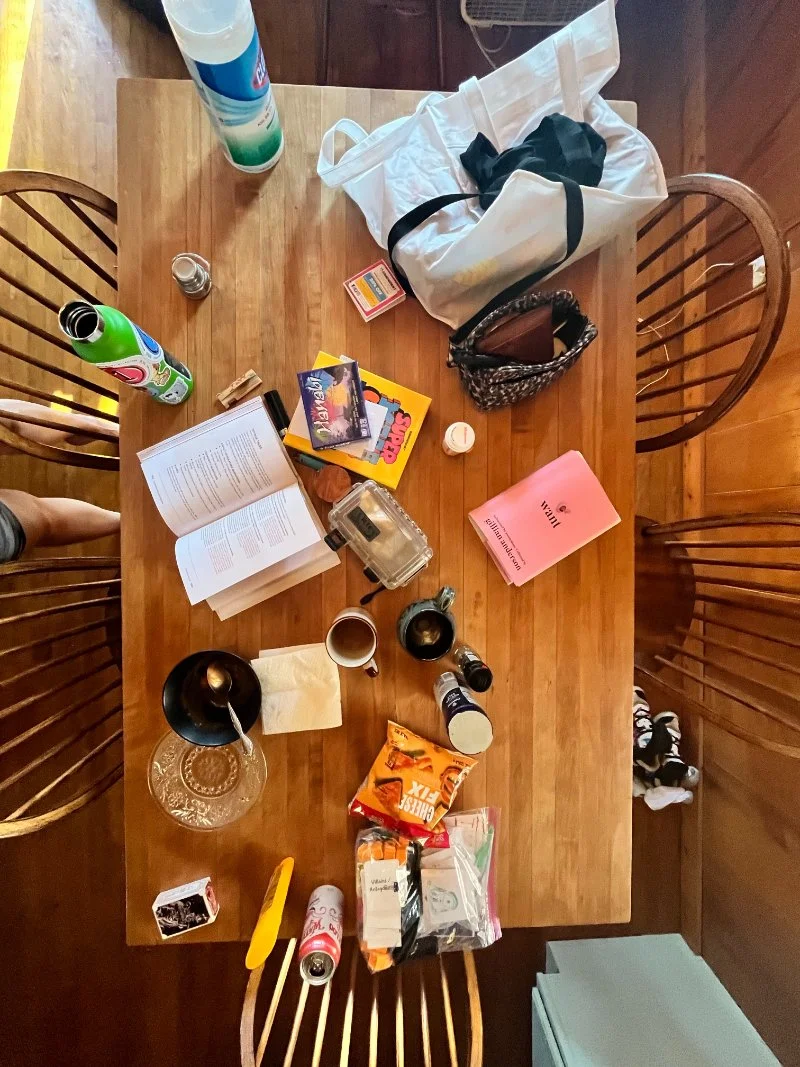
The bugger is (for people like me, anyway) a box I put away for later usually becomes a Doom Box: I'm not sure what's in it, but I'm sure it's important. I might be a bit scared to look in it, so I leave it for Future Me, who never seems to have the capacity to look in it either. It collects dust, and it becomes a clutter magnet, because random things seem to find their way onto any existing pile.
Deanna's kids have ‘Maybe’ boxes under their beds, and there's a similar idea from Dawn Madsen of The Minimal Mom called the "Time Will Tell" bin. It's a holding zone, so if you haven't gone looking for anything in it after a month or three, it's probably safe to let it go.
For some people, this works beautifully. For me, it becomes a danger zone I'd rather not go near. (You'll know which one you are.) If you're like me, it's easier to make the decision then and there and move on with your life.
(When you get to the point where you think, "No, I need that space back now," that's when we can work through the Doom Box together!)
How To Start Turning Down The Visual Noise
The No-Mess Decluttering Method, created by Dana K White, is how I work with every client. We never pull everything out, we never make a bigger mess, and you can stop at any time with your space already better off. Within that, here's where I'd start.
Start with the easy stuff. We don't begin with your sentimental collection. We begin with the wrappers on your desk that belong in the bin and the things you already know can go. Each one you remove is one less thing calling for your attention.
Clean up your own side of the street first. It's so easy to look at someone else's stuff and decide it clearly has to go. Meanwhile, I have a pile of watercolour supplies for when I suddenly become a watercolourist! Have I ever watercoloured? No. My husband sees a pile; but I see potential. So I always suggest starting with your own things, then shared things, and respecting the people you live with when it comes to their belongings.
Ask what fits, not what it could be. When ‘infinity brain’ kicks in, come back to your container. Does this have a home in the space you've got?
Stop whenever you need to. Ten minutes totally counts! With the No-Mess Method, there's no pile waiting to be dealt with later, so every session leaves you with a little less visual noise than before.
If you'd like the full process, here's how to declutter your home without making a bigger mess.
The wins that come with just decluttering can be so much bigger than you'd expect. After we cleared a lot of stuff out of our house, I remember thinking it felt like an Airbnb. It was so easy to keep clean, the dishes weren't taking five hours, and I wasn't spending all my time picking things up and putting them away. Less stuff meant less housework, and honestly, that alone felt like the heavens had opened (hallelujah!)
A Heads-Up For Stuff Accumulation Season
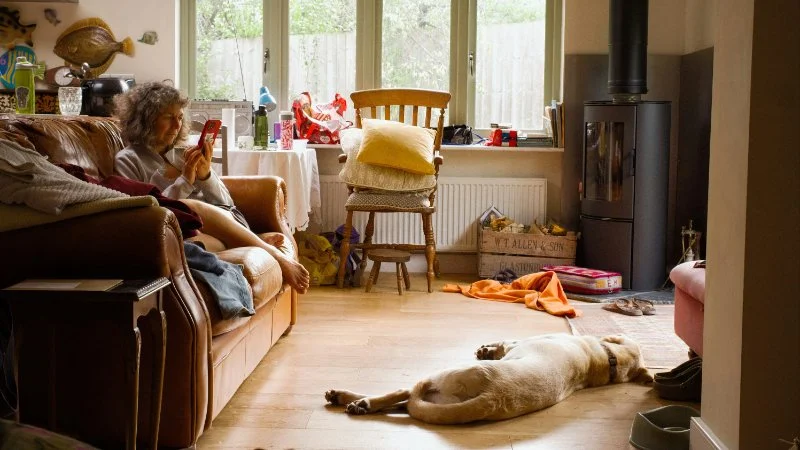
The holidays are lovely, and they're also Stuff Accumulation Season. Between Black Friday sales and Christmas gifts coming in from every direction, a lot of us look around on Boxing Day with a stuff hangover, wondering where it all came from.
If you have a little capacity right now, clearing out a Doom Box or a corner that's adding to the visual noise is a great way to make room before the influx arrives. A few minutes here and there really does add up!
Less Visual Noise, More Room To Live
You don't need a fancy system or a single new container to quiet things down. Removing some of the stuff in your space lowers the visual noise, gives your brain room to breathe (and gives the squirrels their cup of tea).
If you'd like someone who really understands to support you through it, I’d be delighted to help!
Local to Canberra? My Canberra decluttering services offer one-on-one help in your home.
Prefer to work from wherever you are? My online decluttering services bring support to you, anywhere in the world.
Not sure which one fits? Book a free one-hour consultation. There's no pressure and no judgment, and we'll get started on your space together.
Want more simple, kind tips like these? Join the Hello Space newsletter, and I'll send brain-friendly decluttering ideas straight to your inbox.
Frequently Asked Questions
-
Visual noise is that overwhelmed, ‘sensory overload’ feeling you get from looking at a lot of things that are out of order, like a desk covered in half-finished projects and paperwork you haven’t decided what to do with, or a corner where bags of hand-me-downs and things to return have piled up together. Part of what makes it distressing is that you can see things need putting back in order, but it’s hard to know where to start.
There’s some research behind that feeling. When lots of things are in view at once, they compete to be processed in the visual part of your brain, which can only handle so much at a time (McMains and Kastner, 2011). Studies of real homes are small and can’t show what causes what, but in one study, wives who described their homes as cluttered and unfinished had less healthy daily patterns of the stress hormone cortisol (Saxbe and Repetti, 2010).
Visual noise can be harder to tune out if you have ADHD (or wonder if you might), are Autistic, or have sensory sensitivities. I’ve found the biggest difference comes from removing some of the stuff, because every item that leaves is one less thing for your brain to process.
-
Yes, a lot of people find it does. Each pile is usually made up of lots of small decisions you haven’t made yet (does this stay, and where does it live?), and seeing them all at once can feel like a to-do list that grows every time you walk past.
People who feel clutter affects their daily lives tend to report more negative feelings and lower wellbeing, although the effect is small and studies can’t yet show which causes which (Quinn, 2025).
If you’re already low on energy, that overwhelm can make it hard to know where to start. I’ve found it helps to begin with things you can easily identify as clutter, like rubbish and things that are just out of place and can go straight back where they belong. That way there’s already less to look at before you get to anything that takes more thought.
-
Sorting out clutter can be more challenging for people with ADHD due to brain-based differences in the cognitive processes that help us plan, prioritise and make decisions. So a pile on the dining table can look like a long list of decisions, with no obvious place to start.
Clutter also seems to be linked with inattention in particular. In a study of 801 university students in Japan, how cluttered people rated their rooms was more closely linked with inattention than with hyperactivity or impulsivity, although the link was modest (Kajitani et al., 2019).
Many people with ADHD also leave things out on purpose, because once something’s put away, it’s easy to forget it exists. Keeping things in view is a strategy that can sometimes support ADHD-related challenges with working memory, but when there are a lot of things out at once, it can start to feel overwhelming instead of helpful.
If you’re also sensitive to visual noise, a room where lots of things are out of place can start to feel overwhelming even sooner. So while clutter can genuinely be harder to manage with ADHD, it doesn’t say anything about you as a person, or how hard you’re trying.
-
A Doom Box is a container that we’ve filled up with a mix of stuff from a cluttered surface or space, with a plan to sort it out later. The internet tells me the name stands for ‘Didn’t Organise, Only Moved’.
If you’re anything like me, Doom Boxes generally start life when you’re panicking to get stuff out of sight before the doorbell rings. It’s a completely understandable way to cope, but once the lid’s on, it’s easy to forget what’s inside, and the box often ends up stacked in a cupboard or a corner for months.
When you feel ready to sort out a Doom Box, I recommend starting with Dana K White’s ‘Look, Look, Always Look’ strategy: open the box and allow yourself to just take a quick look inside. In my experience, there’s often less in there to worry about than you expected.
Then work through it in little bursts with Five-Minute Tidy-Ups. Set a timer for five minutes, throw away any obvious rubbish, then start on the Easy Stuff (anything that has a home somewhere else). When the timer goes off, you’re allowed (and encouraged!) to stop, and the box gets a little smaller each time.
Next time the urge to shove everything in a box feels really strong, if you can, experiment with bypassing the middleman of the box and quickly popping things back in their established homes instead. Dana K White calls this “take it there now”, and I’ve found it works well, both right then and in the long run.
With people on their way, it’s natural to worry there won’t be time for that, but you might be surprised how quick it is to take it there now. Every job gets all the way done, so there’s no box of decisions waiting for later.
-
The Container Concept is the idea that the space you have sets the limit on how much you can keep. A container is any space that holds stuff, like a drawer, a shelf, a cupboard or even your whole house, and once it’s full, anything that doesn’t fit can go. It comes from Dana K White, and it’s the idea behind ‘Does it Fit?’, the last step of the No Mess Decluttering Process I use with clients.
When we get to this step together, we put the favourites in first. A useful question here is, “Which one of these deserves room the most?” It helps you identify which things you’d rather prioritise having space for when there’s only so much room, instead of deciding whether each thing is good enough to keep, and it’s a process that’s always guided by you.
It also helps me make decluttering decisions in my own home. We live in a late-1970s house without much in the way of built-in storage, and it’s definitely not a McMansion. So when a cupboard is full, that’s my signal that something needs to leave before I can put anything new in it.